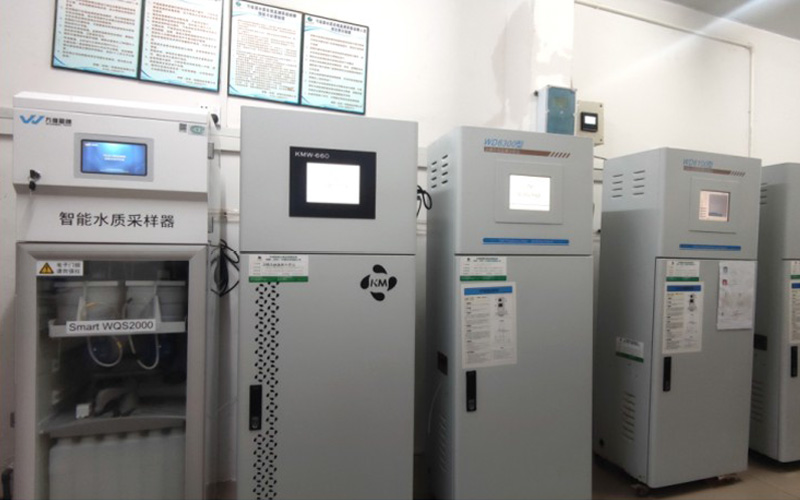
Water is the source of life, and water quality is an important measure of ecosystem health. Among numerous water quality indicators, total nitrogen content is like a key that can unlock the "digital password" for interpreting the health status of the water environment. With the rapid development of online monitoring technology,Online monitoring of total nitrogenIt is becoming the forefront of water ecological protection, providing unprecedented data support and decision-making basis for environmental managers.

Total nitrogen: a barometer of aquatic ecological health
As a core indicator reflecting the degree of eutrophication in water bodies, the concentration changes of total nitrogen directly reveal the nutritional status and potential pollution risks of water bodies. In natural water bodies, nitrogen exists in various forms, including nitrate nitrogen, nitrite nitrogen, ammonia nitrogen, and organic nitrogen. These different forms of nitrogen compounds are transformed into each other through complex biogeochemical cycles, collectively forming the nitrogen cycling network of aquatic ecosystems.
When the total nitrogen concentration exceeds the natural carrying capacity, it will break this delicate balance, causing a series of ecological problems such as abnormal algal growth and decreased dissolved oxygen. Behind phenomena such as "algal blooms" in lakes and "red tides" in coastal areas, the shadow of excessive nitrogen input can often be found. Therefore, accurately grasping the dynamics of total nitrogen is equivalent to mastering the important password for predicting and preventing water ecological risks.
Technological innovation: a leap from laboratory to online monitoring
Traditional total nitrogen monitoring relies on manual sampling and laboratory analysis, which is not only time-consuming and laborious, but also has scattered data, making it difficult to capture the continuous trajectory of water quality changes. With the integration and development of technologies such as spectral analysis, electrochemical sensing, and the Internet of Things, the online monitoring equipment for total nitrogen has achieved a qualitative change from "visible" to "clear".
Modern online monitoring systems can accurately determine total nitrogen on a minute scale using advanced technologies such as UV digestion persulfate oxidation and high-temperature catalytic oxidation. These devices are like "stethoscopes" for water bodies, constantly monitoring changes in water quality 24 hours a day and converting complex nitrogen cycling processes into interpretable digital signals. It is worth mentioning that the introduction of intelligent algorithms has enabled monitoring data to have self verification and anomaly warning functions, greatly improving the reliability and practicality of the data.
Data Empowerment: Building a Smart Management System for Water Ecology
The massive data generated by online monitoring can only be truly transformed into the wisdom of ecological management through professional decoding. By establishing a correlation model between total nitrogen and other water quality parameters, researchers can trace pollution sources and identify key control nodes. In a governance case of a large lake, the manager accurately identified the main entry channels of agricultural non-point source pollution through an online monitoring network for total nitrogen, providing scientific targeting for precise governance.
The construction of big data platforms further unleashes the value of monitoring data. The functional modules of spatiotemporal dynamic visualization, trend prediction simulation, and governance effect evaluation upgrade the total nitrogen data from a simple monitoring indicator to a decision support tool. In key areas such as the Yangtze River Economic Belt and the Guangdong Hong Kong Macao Greater Bay Area, online monitoring data of total nitrogen has become an important basis for evaluating the ecological environment quality of river basins and formulating green development policies.
Future prospects: Ecological value of intelligent monitoring networks
With the deep integration of technologies such as 5G and artificial intelligence, online monitoring of total nitrogen is developing towards a more intelligent and accurate direction. Innovative methods such as microsensors and drone mobile monitoring will fill the spatial gap in existing monitoring networks; The application of blockchain technology is expected to solve the problems of data authenticity and traceability; Machine learning algorithms will continuously enhance the depth and breadth of data analysis.
It can be foreseen that a more comprehensive, responsive, and intelligent total nitrogen monitoring network will become the "nerve center" for water ecological health assessment. This digital password system can not only timely warn of ecological risks, but also provide quantitative support for the systematic governance of the "mountains, waters, forests, fields, lakes, and grasses" community of life, playing an irreplaceable role in the great journey of building a beautiful China.

Runjin (Shenzhen) Environmental Technology Co., Ltd
Runjin (Shenzhen) Operation and Maintenance Center
Shenzhen Headquarters: No. 162 Shajiang Road, Xitou Community, Songgang Street, Bao'an District, Shenzhen, Guangdong Province (Building 2, Xinweirun High tech Park, 10th Floor, 1006)
Contact phone number: 19166393026
Kaiming KMW Water Quality Monitor Channel Cooperation Contact Number: 13828819385

Runjin Huanke WeChat official account
Channel distributors, please scan the code for consultation
 Service Hotline:19166393026