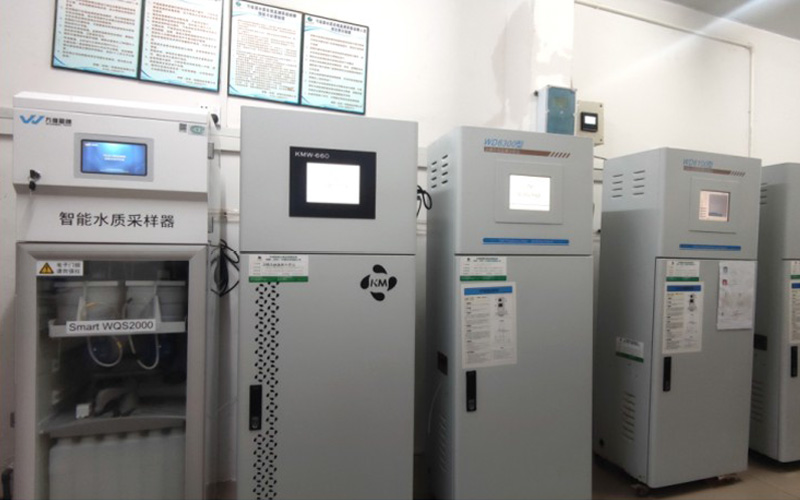
At the forefront of water resource conservation today,Online monitoring of total phosphorusThe system is like a high-tech "digital sentinel" force, constantly guarding the health and balance of the aquatic ecosystem 24 hours a day. These sophisticated analytical instruments and intelligent data platforms form the nerve endings of modern water environment management, providing scientific basis and warning mechanisms for water ecological protection through real-time and accurate monitoring of total phosphorus concentration.

Phosphorus pollution: an invisible driving force behind eutrophication of water bodies
Phosphorus, as an essential nutrient for life, can become the initiator of ecological disasters once it accumulates excessively in water bodies. The excessive total phosphorus caused by factors such as agricultural non-point source pollution, domestic sewage discharge, and improper treatment of industrial wastewater is a key factor leading to eutrophication of water bodies. A series of chain reactions such as algal blooms, dissolved oxygen depletion, and loss of aquatic biodiversity are closely related to phosphorus concentration. The traditional manual sampling and laboratory analysis methods have inherent defects such as poor timeliness and discontinuous data, which are difficult to meet the needs of modern water environment management.
Technological breakthrough: a leap from intermittent sampling to intelligent monitoring
The modern total phosphorus online monitoring system integrates multiple cutting-edge technologies such as spectral analysis, microfluidic chips, and the Internet of Things, achieving a qualitative leap from "post analysis" to "process monitoring". The latest generation of monitoring equipment adopts the principle of ammonium molybdate spectrophotometry. Through intelligent digestion modules and precision optical systems, the entire process from sampling to data analysis can be completed within 30 minutes, with a detection limit of 0.01mg/L. The integration of Beidou positioning and 5G transmission technology enables real-time uploading of monitoring data to cloud platforms, building a comprehensive water quality monitoring network covering the entire area.
The practice of a certain watershed management bureau shows that after deploying an online monitoring system, the detection time of total phosphorus abnormal events has been advanced by an average of 72 hours, and the emergency response efficiency has been improved by more than 60%. These 'digital sentinels' not only significantly reduce the cost of manual monitoring, but also provide data support for precise pollution control by establishing a complete spatiotemporal distribution map of phosphorus pollution.
System composition: Three in one intelligent monitoring system
A complete online total phosphorus monitoring system consists of three core components: front-end perception layer, data transmission layer, and platform application layer. The front-end perception equipment is equipped with intelligent functions such as automatic cleaning, fault diagnosis, and standard solution verification to ensure long-term stable operation under complex working conditions; Data transmission adopts redundant design, supporting both wired and wireless dual channels; The cloud platform integrates advanced functions such as big data analysis, pollution tracing, and early warning and forecasting, achieving closed-loop management from monitoring to decision-making.
It is worth mentioning that these systems generally adopt modular design, which can be flexibly configured according to the monitoring needs of different water bodies. For key lakes and reservoirs, a vertical profile monitoring module can be added; At the discharge outlet of the river, the instantaneous sampling capability should be strengthened; For decentralized water sources in rural areas, a simplified version with small size and low power consumption has been developed, demonstrating good environmental adaptability.
Application scenario: Full process protection from source to end
In the Yangtze River Economic Belt, the online monitoring network for total phosphorus has covered key sections of the main stream and major tributaries, forming a tight prevention and control network. The the Taihu Lake Lake Basin has realized the correlation analysis of cyanobacteria bloom and total phosphorus concentration by building an integrated monitoring system of "air sky earth", and the early warning accuracy rate has reached more than 85%. Industrial parks will link online monitoring data with pollution discharge permit management, forcing enterprises to upgrade their sewage treatment processes.
Even more innovatively, some regions have begun to attempt to combine monitoring data with ecological compensation mechanisms. The total phosphorus pollution compensation standard established in a cross provincial watershed is based on online monitoring data as the accounting basis, creating a new market-oriented governance model of "whoever pollutes pays". This precise monitoring based environmental and economic policy has greatly mobilized the enthusiasm of upstream areas for pollution control.
Future prospects: Deep integration of intelligent monitoring and ecological governance
With the miniaturization of sensors and the development of artificial intelligence algorithms, the next generation of total phosphorus monitoring technology is evolving towards higher intelligence and lower cost. The application of nano material sensors is expected to shorten the detection time to the minute level; The introduction of edge computing technology can enable devices to have the ability of localization analysis; The integration of blockchain technology can ensure the immutability of monitoring data and enhance credibility.
It can be foreseen that these constantly evolving "digital sentinels" will form a three-dimensional monitoring network with technologies such as drone patrols, satellite remote sensing, and underwater robots, providing multidimensional data for the health assessment of aquatic ecosystems. More importantly, through cross-border integration with socio-economic data, online monitoring of total phosphorus will not only be a technological means, but also an important indicator for measuring the level of regional green development, promoting the formation of a virtuous cycle between water resource protection and economic and social development.
On the new journey of ecological civilization construction, the "digital sentinel" team of total phosphorus online monitoring system will continue to upgrade equipment and expand defense lines, using the power of technology to protect the ecological security of every water area, leaving a beautiful home with clear water, green banks, and shallow bottoms for future generations.

Runjin (Shenzhen) Environmental Technology Co., Ltd
Runjin (Shenzhen) Operation and Maintenance Center
Shenzhen Headquarters: No. 162 Shajiang Road, Xitou Community, Songgang Street, Bao'an District, Shenzhen, Guangdong Province (Building 2, Xinweirun High tech Park, 10th Floor, 1006)
Contact phone number: 19166393026
Kaiming KMW Water Quality Monitor Channel Cooperation Contact Number: 13828819385

Runjin Huanke WeChat official account
Channel distributors, please scan the code for consultation
 Service Hotline:19166393026