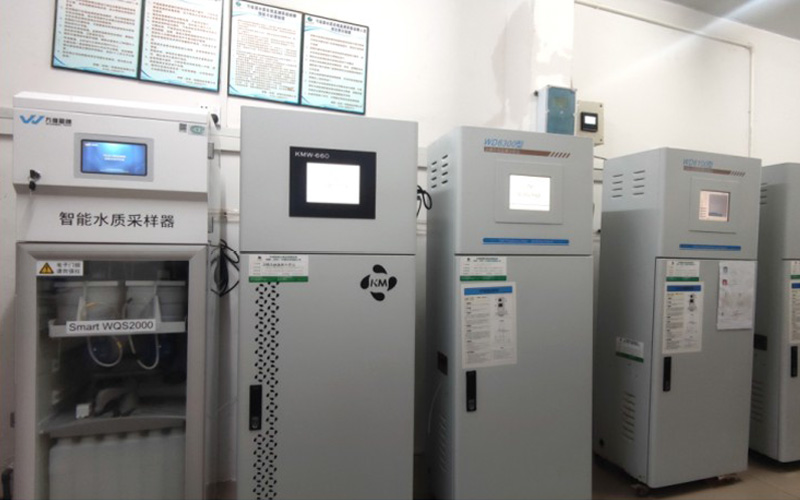
With the deepening of China's water pollution prevention and control work, the online monitoring technology of total nitrogen, as an important tool for environmental supervision, is constantly improving its technical specification system. The latest release in 2023Online monitoring of total nitrogenThe technical specifications (HJ 1025-2023) provide systematic provisions in terms of method principles, equipment performance, quality control, etc., providing technical support for precise water environment management.
1、 Analysis of Core Points of Technical Specifications
Expansion of methodology system
The new standard adds innovative methods such as gas-phase molecular absorption spectroscopy and chemiluminescence based on the traditional alkaline potassium persulfate digestion UV spectrophotometry method, with a strict detection limit controlled below 0.1mg/L. Special provisions have been made for the applicable conditions of high-temperature catalytic oxidation method, requiring a catalyst life of ≥ 6 months and a stable oxidation efficiency of over 98%.
Performance indicator upgrade
The range is divided into three levels: 0-10mg/L, 0-50mg/L, and 0-100mg/L
Zero drift ≤± 5% F.S./24h, range drift ≤± 10% F.S./24h
The actual water sample comparison error is controlled within ± 15% (± 0.15mg/L when the concentration is ≤ 1mg/L)
Strengthening the quality control system
Introduce a "three-level quality control" mechanism: equipment manufacturers need to complete 168 hours of continuous operation testing; Conduct 72 hour comparative monitoring during installation acceptance; At least one actual water sample verification shall be conducted per month during the operation phase. Specially added requirements for anion interference experiments, specifying the anti-interference performance indicators for Cl - ≤ 1000mg/L and SO42- ≤ 500mg/L.
2、 Key technological breakthrough direction
Dissolve technological innovation
The microwave-assisted digestion device requires a digestion temperature of up to 123 ± 1 ℃, pressure stability controlled at 0.14 ± 0.02MPa, and digestion time shortened to within 15 minutes. A certain brand of equipment adopts gradient temperature control technology, which improves the decomposition efficiency of potassium persulfate to 99.7%.
Optical detection optimization
The UV spectroscopic system needs to be equipped with deuterium lamp background correction, with a spectral bandwidth of ≤ 2nm
The optical path difference compensation accuracy of the dual beam design reaches ± 0.5nm
The new photodiode array detector can achieve full band scanning of 190-400nm
Intelligent operation and maintenance system
The standard requires equipment to have functions such as automatic cleaning (cleaning cycle can be set), abnormal data labeling, remote calibration, etc. A monitoring station application case shows that equipment equipped with an AI diagnostic system can shorten the fault response time to within 2 hours.
3、 Key steps in implementing applications
Site selection and layout standards
Sewage treatment plants should set up separate points at the end of the biochemical tank and the main discharge outlet
The surface water monitoring section needs to meet the hydraulic conditions of the first 10 times and the last 5 times
The size of the installation platform shall not be less than 1.5m × 1.0m, and the height from the water surface shall be greater than 0.5m
Data validity assessment
Collect 1 set of data every 15 minutes, with an effective data volume of ≥ 4 sets per hour
Quarterly operational rate ≥ 90%, data capture rate ≥ 85%
The temperature compensation module needs to undergo accuracy verification every 6 months
Compare monitoring requirements
Adopting the national standard method (HJ 636-2012) for parallel sampling, it is stipulated that:
When the concentration is less than 2mg/L, the absolute error is ≤± 0.3mg/L
When the concentration is 2-10mg/L, the relative error is ≤± 15%
Conduct at least 3 concentration level comparisons every quarter
Currently, more than 200 key polluting units in the Yangtze River Delta region have completed the update of new standard equipment, and the consistency between monitoring data and manual monitoring has increased to over 92%. With the integration and application of Internet of Things technology, online monitoring of total nitrogen is developing towards a closed-loop management model of "intelligent perception cloud analysis warning decision-making", providing more accurate data support for water environment quality management. It is recommended that relevant units focus on new regulations such as verification of digestion efficiency and elimination of anion interference, and make equipment upgrades and technical reserves in advance.

Runjin (Shenzhen) Environmental Technology Co., Ltd
Runjin (Shenzhen) Operation and Maintenance Center
Shenzhen Headquarters: No. 162 Shajiang Road, Xitou Community, Songgang Street, Bao'an District, Shenzhen, Guangdong Province (Building 2, Xinweirun High tech Park, 10th Floor, 1006)
Contact phone number: 19166393026
Kaiming KMW Water Quality Monitor Channel Cooperation Contact Number: 13828819385

Runjin Huanke WeChat official account
Channel distributors, please scan the code for consultation
 Service Hotline:19166393026