The key role and in-depth analysis of total phosphorus online monitoring technology in wastewater treatment
Current situation and hazards of total phosphorus pollution
Phosphorus, as an essential element for life, circulates in nature, but when it is excessively discharged into water bodies, it can cause a series of environmental problems. Modern industrial wastewater, agricultural runoff, and domestic sewage contain a large amount of phosphorus compounds. After these pollutants enter the water body, they can cause explosive reproduction of algae and other planktonic organisms, consume dissolved oxygen in the water, and form a "algal bloom" phenomenon, ultimately leading to eutrophication of the water body. According to environmental monitoring data, about 60% of lakes and reservoirs in China are facing varying degrees of eutrophication threats, with excessive total phosphorus being one of the main reasons.
Phosphorus pollution not only disrupts the balance of aquatic ecosystems, but also affects human health through the food chain. Long term consumption of water with excessive phosphorus content may interfere with human calcium and phosphorus metabolism, and certain organic phosphorus compounds have been proven to have carcinogenic risks. Therefore, strict control of total phosphorus content in wastewater has become a top priority in environmental protection work.
Principle of Total Phosphorus Online Monitoring Technology
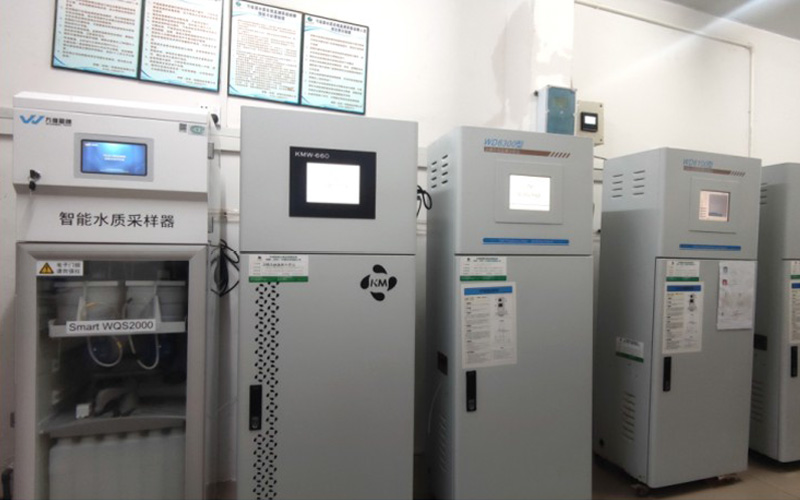
The online monitoring system for total phosphorus is an indispensable "eye" in modern wastewater treatment plants. It achieves real-time monitoring of total phosphorus concentration in wastewater through automated analysis methods. The current mainstream online monitoring technology for total phosphorus is mainly based on the principle of ammonium molybdate spectrophotometry, and its workflow can be divided into three key stages:
Firstly, in the sample pretreatment stage, the system automatically collects wastewater samples and converts various forms of phosphorus (including organic phosphorus, polyphosphate, etc.) into measurable orthophosphate through high-temperature and high-pressure digestion or ultraviolet oxidation. This step is crucial as it determines the representativeness and accuracy of the monitoring results.
Next is the color reaction stage. Under acidic conditions, orthophosphate reacts with ammonium molybdate reagent to form phosphomolybdic acid, which is then reduced by ascorbic acid to form a deep blue phosphomolybdic blue complex. The color depth of this compound is directly proportional to the total phosphorus concentration, laying the foundation for subsequent optical detection.
Finally, in the optical detection stage, the system illuminates the sample with a specific wavelength (usually 880nm) light source, measures the changes in transmitted or scattered light intensity, and calculates the total phosphorus concentration value based on the Beer Lambert law. Modern instruments are also equipped with automatic calibration and cleaning functions to ensure the stability of long-term monitoring.
Composition and workflow of online monitoring system
A complete online monitoring system for total phosphorus consists of multiple precision components working together to form an efficient monitoring network. The sampling unit is responsible for regularly collecting representative samples from key nodes in the wastewater treatment process, such as inlet, biochemical tank, outlet, etc. It is usually equipped with self-cleaning function to prevent pipeline blockage and cross contamination.
The sample processing unit is the core of the system, including modules such as automatic dilution, digestion, and filtration, which can adapt to wastewater samples with different concentration ranges and turbidity. The high-temperature and high-pressure digestion device can reach a working temperature of 120-150 ℃, and with the help of strong oxidants, it can achieve complete conversion of various phosphorus compounds.
The analysis and detection unit integrates precision optical systems and fluid control systems, using high-sensitivity photodiodes or CCD detectors, with a detection limit of up to 0.01mg/L, fully meeting the monitoring requirements of Class V surface water standards (total phosphorus ≤ 0.4mg/L). The data processing unit is responsible for signal conversion, data storage, and abnormal alarm, and real-time transmission of monitoring data to the environmental supervision platform through 4G/5G or fiber optic networks.
The typical workflow is that the system automatically completes a monitoring cycle every 30-60 minutes, including sampling, preprocessing, reaction, detection, cleaning, and other steps. The monitoring data is refreshed every minute to form a continuous trend curve, providing real-time basis for process adjustments. When the detection value exceeds the preset threshold, the system will trigger an audible and visual alarm and automatically send warning information, achieving early detection and disposal of pollution events.
Advantages and Application Value of Online Monitoring Technology
Compared to traditional laboratory analysis, online monitoring technology for total phosphorus exhibits significant advantages. In terms of real-time performance, traditional methods require manual sampling and inspection, usually taking 1-2 days to obtain results, while online monitoring can achieve minute level response speed and timely detection of abnormal emissions. In terms of accuracy, the online system avoids the risk of deterioration during sample transportation and storage, and automated operations reduce human errors, resulting in higher data reliability.
From an economic perspective, although the initial investment in online monitoring equipment is relatively large (about 150000 to 300000 yuan per system), the long-term operating costs are significantly lower than frequent laboratory analysis. A system can simultaneously cover multiple monitoring points, achieving 24-hour uninterrupted work and significant savings in labor costs. Taking a sewage treatment plant with a daily capacity of 100000 tons as an example, adopting online monitoring can reduce annual operating costs by about 400000 yuan.
In the field of environmental supervision, the online monitoring data of total phosphorus is directly uploaded to the environmental protection department through a dedicated transmission protocol, eliminating the possibility of human tampering and providing ironclad evidence for environmental law enforcement. Many regions have used online monitoring data as a direct basis for pollution discharge fees and environmental taxes, forcing companies to strengthen pollution control. According to statistics, after the comprehensive implementation of online monitoring, the total phosphorus emission compliance rate of key polluting units has increased by 25 percentage points.
Technical Challenges and Development Trends
Although online monitoring technology for total phosphorus is becoming increasingly mature, it still faces several challenges in practical applications. Complex matrix interference is the primary challenge, especially for industrial wastewater containing a large amount of organic matter, heavy metals, or suspended solids, which can easily lead to incomplete digestion or abnormal color development. In response to this issue, the new generation of monitoring systems has begun to adopt enhanced pretreatment techniques such as microwave digestion and ozone oxidation, combined with chemical masking agents to eliminate interference.
Another challenge is the high professional requirements for operation and maintenance. Reagent replacement, pipeline cleaning, calibration verification and other operations need to be carried out regularly by professional personnel, otherwise it is easy to cause data drift. To solve this problem, device manufacturers are developing self diagnostic and self maintenance functions, using IoT technology to achieve remote operation and maintenance guidance, and lowering the technical threshold for users.
In the future, online monitoring technology for total phosphorus will develop in several directions: in terms of miniaturization, portable monitoring devices based on microfluidic chips can achieve rapid on-site detection; In terms of intelligence, combined with artificial intelligence algorithms, the system can automatically identify abnormal data and provide processing suggestions; In terms of multifunctionality, one device can simultaneously monitor multiple parameters such as total phosphorus, orthophosphate, and organic phosphorus, meeting the needs of different scenarios.
Of particular note is the development of spectroscopic techniques, such as laser-induced breakdown spectroscopy (LIBS) and X-ray fluorescence spectroscopy (XRF), which require no chemical reagents for detection and are making breakthroughs in the laboratory stage. They are expected to achieve truly non-destructive and continuous monitoring in the future.
Conclusion
The online monitoring technology of total phosphorus, as the "sentinel" in the field of wastewater treatment, plays an irreplaceable role in the battle against pollution prevention and control. With increasingly strict environmental standards and regulatory requirements, this technology will continue to iterate and upgrade, providing strong technical support for improving water environment quality. For polluting enterprises, investing in advanced online monitoring systems is not only a need to fulfill environmental responsibilities, but also a strategic choice to improve management level and achieve green development. In the future, with the integration and application of new technologies such as 5G, Internet of Things, and artificial intelligence, online monitoring of total phosphorus will inevitably move towards a more intelligent and accurate new stage, contributing greater strength to the construction of a beautiful China.

Runjin (Shenzhen) Environmental Technology Co., Ltd
Runjin (Shenzhen) Operation and Maintenance Center
Shenzhen Headquarters: No. 162 Shajiang Road, Xitou Community, Songgang Street, Bao'an District, Shenzhen, Guangdong Province (Building 2, Xinweirun High tech Park, 10th Floor, 1006)
Contact phone number: 19166393026
Kaiming KMW Water Quality Monitor Channel Cooperation Contact Number: 13828819385

Runjin Huanke WeChat official account
Channel distributors, please scan the code for consultation
 Service Hotline:19166393026